An interview with Publishers Weekly
March 22, 2015
 Comments Off on An interview with Publishers Weekly |
  Uncategorized |
  Permalink
 Posted by billayers
An article on VoW
March 21, 2015
Comments Off on An article on VoW | Uncategorized | Permalink
Posted by billayers
From the Museum of Education…
March 17, 2015
Comments Off on From the Museum of Education… | Uncategorized | Permalink
Posted by billayers
Speaking this week at Penn State and Penn
March 14, 2015I’m speaking Thursday and Friday at Penn State University, and Saturday at Penn in Philadelphia. As usual a small but noisy group is stirring up opposition, led by an ill-informed state senator. I was moved to dig up a couple of excerpts from PUBLIC ENEMY:
Cancellations and abandonment continued apace and the tempest leapt completely out of the teapot: officials at the University of Wyoming, citing “security threats” and “controversy,” canceled two talks I’d been asked to give there, one a public lecture entitled “Trudge Toward Freedom: Moral Commitment and Ethical Action,” and the other, a talk to faculty and graduate students called “Teaching and Research in the Public Interest: Solidarity and Identity.” One week before I was to travel to Laramie, I was told I had been “disinvited.”
A campaign to rescind the invitation had been initiated on right-wing blogs months earlier, accelerating quickly to a wider space where a demonizing storyline dominated all discussion and a wave of hateful messages and death threats hit the University, joined soon enough by a few political leaders and wealthy donors instructing officials in ominous tones to cancel my visit to the campus, or else. This was becoming drearily familiar to me.
A particularly despicable note in that campaign was written by Frank Smith who lived in Cheyenne and was active in the Wyoming Patriot Alliance: “Maybe someone could take him out and show him the Matthew Sheppard (sic) Commerative (sic) Fence and he could bless it or something.” He was referring to Matthew Shepard, the young gay man who was tortured and murdered in 1998, left to die tied to a storm fence outside Laramie.
Republican gubernatorial candidate Ron Micheli released a letter he’d sent to the trustees asking them to rescind the invitation, and Matt Mead, another gubernatorial candidate, said that while he was a self-described “fervent believer in free speech and the free exchange of ideas,” that allowing me to speak would be “reprehensible.” He concluded that I should have “no place lecturing our students.”
I told the folks who had invited me how sorry I was that all of this was happening to them, but that I thought it would surely pass. Certainly no matter what a couple of thugs threatened to do, I said, I thought not much would happen, and that Wyoming law enforcement could get me to the podium in any case, and that I would handle myself from there as I always do. I thought we should stand together and refuse to accede to these kinds of pressures to demonize and mostly to suppress students’ right to freely engage in open dialogue. After all a public university is not the personal fiefdom or the political clubhouse of the governor, and donors can’t be permitted to call the shots when it comes to the content or conduct of academic matters. We should not allow ourselves to collapse in fear if a howling mob gathers at the gates with flaming torches in hand, in fact, that was when standing up and pushing back became absolutely necessary. I wouldn’t force myself on the university, of course, but I felt that canceling would be terribly unfair to the faculty and students who had invited me, and would send a big message that bullying works. It would be the equivalent of a book-burning, and would be one more step down the slippery slope of giving up on the precious ideal of a free university in a free society.
No good. The university posted an announcement of the cancellation of my visit with a long and rambling comment from President Tom Buchanan that begins with the obligatory assertion that academic freedom is a core principle of the university, but quickly adds that “freedom requires a commensurate dose of responsibility.” We are charged to enact free speech and thought, he wrote, “in concert with mutual respect.” The heckler’s veto had worked perfectly.
I suggested that I show up on campus—no announcement, no security, no fanfare—and stand respectfully in front of the student union with a big sign saying, “Let’s Talk.” I would engage anyone who happened to walk by and chat about anything that came up.
Those who thought that the university “caved in to external pressure,” President Buchanan went on, would be “incorrect:” “this episode illustrated an opportunity to hear and critically evaluate a variety of ideas thoughtfully, through open, reasoned, and civil debate, it also demonstrates that we must be mindful of the real consequences our actions and decisions have on others.” That twisty sentence qualified him to write for the Nation, for while it was impossible to know definitively what he was calling the “episode” that would provide the opportunity to critically evaluate matters—it might have been the public lecture itself or the cancellation of the lecture, it might have been the barbarians at the gates threatening to burn the place down or the foundations or wealthy alumni warning that funds were in the balance—it had an unmistakable Orwellian ring: we cancelled that lecture as an expression of our support for lectures! And it was eerily similar to the warrior classics: we destroyed that village in order to save it! Work will make you free! War is peace!
One of the truly weird qualities of the Buchanan statement was the hole in its center, the deafening silence concerning why the campaign against me was organized in the first place. I’d been an educator and professor for decades and the hard Right had accelerated the lunacy against thousands of folks—activists and artists, commentators and humorists, academics and theorists—who were, like me, open and outspoken radicals. Wherever possible they’d mounted campaigns exactly like the one in Wyoming. Often university officials stood up on principle and resisted the organized gangs; sometimes they compromised, restricting access to talks and surrounding me with unwanted and unnecessary police protection; and sometimes, as in Nebraska and Wyoming, the university bowed deeply, and then turned and ran.
Of course I hadn’t been invited to speak about the 60s or any of this, and it’s unlikely any of it would have come up without the active campaigning and noisy thunder from the tiny crowd of right-wing zealots in the midst of a presidential election. I would have focused my talk in any case on the unique characteristics of education in a democracy, an enterprise that rests on the twin pillars of enlightenment and liberation, knowledge and human freedom. We should all want to wake up and pay attention, to know more, I would have argued, to see more, to experience more in order to do more—to be more competent and powerful and capable in our projects and our pursuits, to be more astute and aware and wide-awake, more fully engaged in the world that we inherit, the world we are simultaneously destined to change.
To deny students the right to question the circumstances of their lives and to wonder how they might be otherwise, or to deny them the freedom to read widely and to speak to the broadest range of people, as Buchanan was doing, was to deny democracy itself.
I was contacted by Meg Lanker, an undergraduate who was just back from serving in the military and had been active in opposing the cancellation of my talk in Wyoming. She was a fighter on every level. “I’m going to sue the university in federal court,” she told me during our first conversation. “And I’m claiming that it’s my free speech that’s been violated—I have the right to speak to anyone I want to, and right now I want to speak to you.” She was young and unafraid, smart and sassy, her dreams being rapidly made and used—no fear, no regret. I liked her immediately.
Meg Lanker’s approach struck me as quite brilliant—students (and not I) were indeed the injured party. “Inviting you wasn’t necessarily an endorsement; I check books out of the library all the time that aren’t pre-approved. Let’s talk, and who knows, maybe we’ll have a big argument. But we have a right to have you here, and they can’t stop us.”
She contacted David Lane, a marvelous people’s lawyer and legal street fighter from Denver, and he filed an injunction against the university—suddenly there we were in court before a conservative federal judge. President Buchanan took the stand to complain about security and, when the judge nudged him to remember the first amendment said, “But doesn’t security trump free speech?” The judge patiently explained that if that were true there would never have been any dissent—including the Civil Rights Movement—in our history. He ruled that the university must accommodate my talk taking whatever security precautions it felt were prudent.
My family worried about me traveling alone across Wyoming and so Chesa, studying for law school finals, volunteered and became the designated hitter.He flew in to meet me at the Denver airport where we rented a car and drove together to Laramie. I wasn’t sure he added much muscle, but we had a lovely drive together and lunch at a dive outside of town with the lawyers and the dissident students, toured the campus with Meg, sat on benches drinking coffee in the beautiful Dick and Lynn Cheney Plaza, and knocked on President Buchanan’s door, but he’d gone home early, so I left him a copy of the US Constitution and the Universal Declaration of Human Rights.
That night close to 1100 people braved a blizzard and showed up for my talk—I wanted to think that they all came to hear what I had to say about justice, democracy, and education, but I was realistic enough to know that I’d have likely had an audience of 50 students without all the drama, but there you are.
I’d been invited to give a named lecture on urban education at Millersville University in Pennsylvania and when I got a call from a dean there I was sure we were about to have the same old well-worn conversation regarding opposition, security, “hope you agree,” “so so sorry,” blah blah blah. But she surprised me: “We are all outraged by the manufactured turmoil that’s engulfed us in the wake of the announcement of your up-coming lecture,” she began. She was calling to arrange a conference-call between me and half dozen top officials to discuss how to respond to the craziness, and even how to “make the controversy a teachable moment.” Millersville buoyed my spirits.
The conversation a few days later was the most thoughtful and principled I’d known throughout all the howling frenzy. The administration was determined to host me in a safe and orderly environment and hold all scheduled events—informal conversations with small groups of students and alums, a planned semi-formal dinner to honor the funder, and the campus-wide lecture—and determined as well to defend academic freedom and give their students and the public a lesson in intellectual courage. The officials assured me that defending the lecture was not a burden to them, but rather it was their duty and their honor. “It’s not about you personally,” one said. “It’s about the mission and the meaning of the university.” They then reviewed a letter written to the campus community by the university president, Francine G. McNairy, an African-American woman, outlining the purpose of the lecture and the reason it would not be cancelled. She wrote in part:
A long-accepted value in higher education is that free inquiry is indispensable to the advancement of knowledge. History is replete with examples of ideas that are now precepts of human knowledge that were initially suppressed because their authors were considered heretics or radicals. The focus of the faculty committee, which more than a year ago invited Dr. Ayers to speak, was to advance the dialogue about effective ideas and successful approaches for closing the educational achievement gap between urban students and their non-urban counterparts. This selection was made devoid of political litmus tests for authors. From an objective standpoint, what should matter are which ideas and approaches work and not who develops them. Free inquiry and free speech are critical elements of academic freedom, which thoughtful Americans from our founding fathers to U.S. presidents and Supreme Court justices, more than 200 years later, have judged essential to preparing students to be productive citizens. University administrators have the obligation to support academic freedom in the academy just as public officials are obliged to support free speech in a democratic society. The protection of academic freedom is necessary to afford faculty and students the right to consider and weigh the value of ideas from all sources…
The head of campus police reviewed some of the threats they’d received, many directed at me, of course, and plenty aimed personally and with vile specificity at President McNairy, and outlined a complicated plan—SWAT team, bomb-sniffing dogs, state and local police—that seemed overly elaborate to me, but I figured that they knew better than I, and what the hell.
Comments Off on Speaking this week at Penn State and Penn | Uncategorized | Permalink
Posted by billayers
March 8, International Women’s Day.
March 8, 2015Started as a Socialist day of action in support of the ILGWU in 1909, it has spread across the globe with a focus on respect, support, recognition and love. Make today a day of justice for women, a day of love expressed in the public square, a day of action for equity, access, recognition, and full equality in every sphere. Happy International Women’s Day everyone!
Comments Off on March 8, International Women’s Day. | Uncategorized | Permalink
Posted by billayers
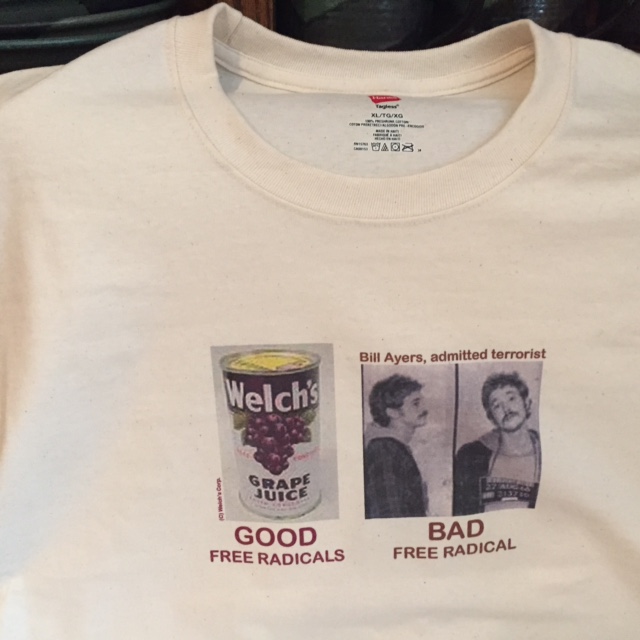
Just arrived from one of my habitually threatening right-wingnuts.
March 4, 2015He suggested I wear it to my next commie-inspired gay wedding, and I think I will.
Comments Off on Just arrived from one of my habitually threatening right-wingnuts. | Uncategorized | Permalink
Posted by billayers
PAPER MACHETE February 21, 2015
February 26, 2015Here is a talk I gave on the Saturday before Rahm Emmanuel , Mayor 1%, got his whooping—he will spend millions in the run-off but the message is clear: Chicago belongs to the people!
Shortly before the last Mayoral Election I was invited to give a keynote speech to an International Anarchist Convention in Greece.
Are you sure you’re anarchists, I kidded the wildly pierced and painted Maria who was ferrying me to the squat we were occupying with her tribe in downtown Athens. Do anarchists have conventions?
“Don’t be fooled,” she said smiling. “This is all a front for chaos and confusion. You’re one of my many props!”
The meetings and the meals, the politics and the people were all great, but one moment stands out as utterly marvelous. I left the convention for a day and travelled to a far island to hang out with Manolis Glezos, the most respected (or reviled) man in all of Greece and well-known throughout Europe for a dazzling act of courage when he was just 19: in 1941 he climbed the Acropolis and tore down the Nazi flag which had flown over Athens since German forces occupied the city. Manolis was captured, thrown into prison and tortured. But now 90 years old and a veteran of seventy years of struggle for peace and justice—imprisoned by the German occupiers, the Italians, the Greek collaborators, and the Regime of the Colonels, he’d spent over a decade behind bars; sentenced to death multiple times; charged with espionage, treason, and sabotage; and escaped prison more than once.
I was interested in the years he served as elected President of the Community Council in Aperathu, an experiment in far-reaching participatory democracy. “We governed by consensus,” he said, “in a massive local assembly with forums like those of the Radical Democracy in ancient Greece.”
They abolished all privileges for elected officials and challenged the idea that “experts” or professional politicians and self-proclaimed leaders were better at running the town’s affairs than ordinary people—they annually drew names from a hat to determine who would act for a year as Commissioner of Parks or Chief of Sanitation.“Every cook can govern!” was theme and watchword.
“The biggest obstacle to revolution here—and in your country as well,” Manolis said, “is a serious and often unrecognized lack of confidence. We spend our lives in the presence of Mayors and Governors and Presidents and Chiefs of Police, and we lose our power of self-reliance—we doubt that we could live without these authorities, and we worship them even as we mock them; soon enough we embrace our own passivity, deny our own agency, and become enslaved to a culture of obedience. That’s a core of our weakness. That’s something you and I must challenge.”
Manolis has been arrested by riot police in front of the Parliament building each year since our meeting, still living the activist life, still battling the murderous system, still opening spaces for more participatory democracy, more peace, and more justice. And, wow! He’s now part of the recently-elected Syriza government.
Confidence.
I returned to Chicago and attended several candidate forums—ten or twelve unmemorable aspirants on a stage with one empty chair reserved for the absent Rahm Emmanuel—he was busy spending his millions, gifts from the banksters and their hedge-fund homies, to run a TV campaign, sparkling constructed images free of any actual interactions with the riffraff.
At each forum I rose with a question: Why do we need a Mayor?
I was regarded as if I were from mars—or Greece. “Don’t be silly.” “You sound like an anarchist.” Hmmm. Still, no one answered the question. Why do we need a mayor?
The One-Percenters have an eerie capacity to grant to themselves a sense of agency and history, values and taste, while writing off everyone else by our statistical profiles: age, income, occupation, ethnicity, place of residence. They have confidence in their big hearts and good intentions, their elite educations and their data-driven brains; their unique ability to quantify and monetize everything. They have little confidence that there is wisdom in every room, that a universe of possibilities resides in every human being. This is frankly inadmissible in a free society or a just world—it’s an affront to any dream of democracy.
[Short aside: In a CPS classroom last week the kids were discussing the merits of an elected versus an appointed school board, and one ten-year old girl said, “But if the Mayor decides by himself won’t he just pick his friends?” Yes, Virginia, there is a Santa Clause; Google Emmanuel’s friend Deborah Quazzo who’s reaped $2.9 million in contracts since taking her seat on the school board. It’s just one example of the new Chicago machine—glitzier perhaps, better dressed, more offensive certainly.]
JP Mitchel, the progressive “Boy Mayor” of New York elected a hundred years ago felt himself uniquely capable of transforming the lives of the downtrodden without bothering to consult the folks he was up-lifting. He never thought that serious participation could be a positive force in his grand plans, and appeared to believe that the dilemmas attending a democracy are best addressed through less, not more, democracy. He was driven from office after a single term—the poor and working class, the homeless and the unemployed had revolted against the consequences to themselves of an undemocratic “autocracy of experts.”
Keep that in mind.
In the 5,000 year history of states, only in the last two centuries has the possibility arisen that states might actually enlarge the realm of human freedom, and only when accompanied by massive extra-institutional energy from social movements. We spend way too much time staring at the sites of power we have no access to—the White House, City Hall—wondering whether the king will grant us what we need and desire, and too little time noticing (and mobilizing) the real power we have absolute access to—the community and the street, the work place, the school, and the hard-earned ballot box, precious but always menaced and fragile.
Note that LBJ passed the most far-reaching civil rights legislation since Reconstruction, but was never part of the Black Freedom Movement; FDR championed important social legislation but was not part of the Labor Movement; and Abraham Lincoln never joined an Abolitionist party, and yet he eventually signed the Emancipation Proclamation. These three are remembered for doing the right thing when it mattered, but always in the face of fire from below.
The brilliant poet Adrienne Rich describes three choices facing city-dwellers like us: The first she calls the “paranoiac”—to arm yourself with mace and triple-lock doors, to never look another citizen in the eye, to live out a vision of the city-as-mugger, depraved and unpredictable with, she notes, “the active collaboration of reality.”
The second she calls the “solipsistic,” to create, if you can, a small fantasy island “where the streets are kept clean and the…[needy and the homeless] invisible,” and to “deplore the state of the rest of the city,” filled with filth and felons, “but remain essentially aloof from its causes and effects.”
These two prototypes are painfully familiar— each of us knows someone crouching in suspicion and alarm, and we know as well those self-absorbed urbanites who say—“I love Chicago,” without a hint of irony as they rush from Uber to health club to carry out accompanied by a comfortable and convenient assumption: my tiny privileged experience is the only story worth knowing.
Adrienne Rich posits a third possibility, an alternative to these destructive and delusional choices, something she herself struggles to name—“a relationship…which I can only begin by calling love.” This is neither romantic nor blind love, but rather a love mixed “with horror and anger… more edged, more costly, more charged with knowledge… love as one knows it…when one is fighting for life, in oneself or someone else. Here was this damaged, self-destructive organism preying and preyed upon. The streets were [laden] with human possibility and vicious with human denial.”
In order to live fully in the city, she concluded, she must above all ally herself with human possibilities. She would embrace the unmapped, the complex, and the imaginable.
Those of us who insist on a decent future for Chicago, for Illinois, our country and the world, might develop relationships that we begin by calling love. We might develop that love—energy draining and energy replenishing—in a struggle for human possibility.
So who should you vote for?
That’s for you to decide.
But look far and be large.
Vote for an elected school board—Chicago’s the only city in the state without one.
Vote for an end to expanding government power to serve only the financially privileged while selling off the public space to the marketeers and the profiteers.
Vote for justice, radical police accountability, and reparations for the survivors of torture.
Vote for an independent inspector general.
Vote as if “we are each other’s business, we are each other’s harvest, we are each other’s magnitude and bond.”
Vote love.
Comments Off on PAPER MACHETE February 21, 2015 | Uncategorized | Permalink
Posted by billayers
Dinesh D’Souza Once More!
February 18, 2015Today’s tweet: A picture of the president of the US with the caption:
“You can take the boy out of the ghetto…”
WOW!! I’m speechless.
Comments Off on Dinesh D’Souza Once More! | Uncategorized | Permalink
Posted by billayers
THIS FRIDAY NITE!!!
February 17, 2015
Comments Off on THIS FRIDAY NITE!!! | Uncategorized | Permalink
Posted by billayers
50 Shots!
February 9, 2015Check out the brilliant photo display “50 Shots” at La Catrina on 18th St. in Pilsen. #BlackLivesMatter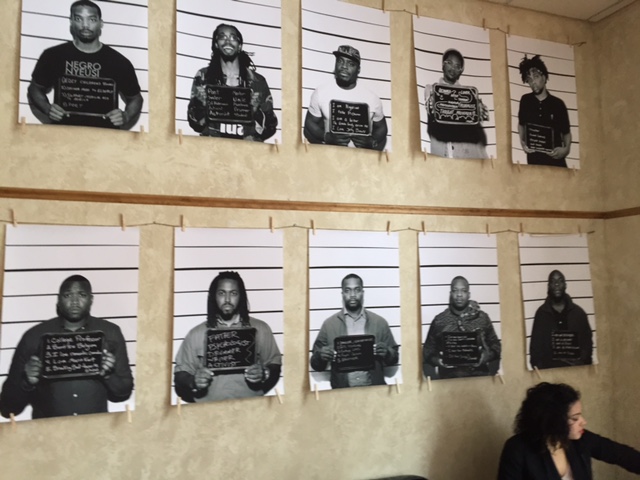
Comments Off on 50 Shots! | Uncategorized | Permalink
Posted by billayers
 Bill Ayers