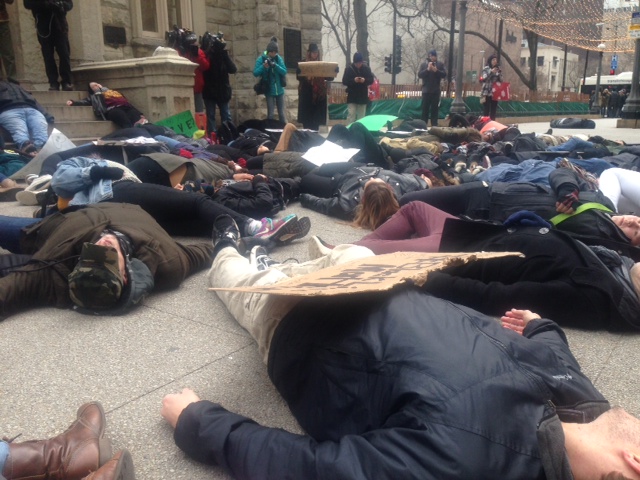
I’m re-reading Herman Melville and thinking about Michael Brown, Trayvon Martin, Kajieme Powell—and the serial killing of young African Americans that characterizes America today.
In Melville’s Benito Cereno a New England sealing ship operating off the coast of Chile in 1805 comes upon a Spanish frigate with a figurehead shrouded in canvass bearing the painted slogan: “Follow your Leader.” The ship is moving forward somewhat aimlessly with tattered sails and a distressed crew. Hoping to assist, a small party led by Captain Amasa Delano boards the ship in order to assess the situation. There they encounter a skeleton crew and a diminished cargo of slaves as well as Captain Benito Cereno who explains the troubles that had brought them to this point: terrible storms, disease and fevers that had taken the lives of several including the slave master Alexandro Aranda, ill fate and bad luck.
Captain Delano spends hours aboard the ship talking with Benito Cereno who is always in the company of his loyal slave and servant, Babo, while observing a series of strange events—urgent whispering among crew and cargo, a few Africans carrying knives and an occasional physical confrontation with Spanish crew members. Benito Cereno is pale and weak, often near fainting, always insisting that Babo stay close. At the end of the visit, as Delano prepares to return to his own ship, a desperate Benito Cereno leaps from the deck into the departing long boat and the truth becomes clear: Babo is running the ship and Benito Cereno is his prisoner; Black insurgents—slaves no more—have taken control and are demanding a return to Africa; the shrouded figurehead is the bones of Alexandro Aranda, the painted slogan a targeted threat to the crew.
The entire day had been a complex performance put on by the enslaved Blacks under the directorial brilliance of Babo to deceive the visitors; in order to see the reality of the drama produced on his behalf—which is bursting with hints and clues and full-blown illumination—Captain Delano, a good liberal Republican from New England, would have needed the one quality he lacked: a deep belief that Babo and the other captives were fully human beings, capable of intricate planning, complex intelligence, wild imaginations, historical memory, and an acute sense of their own agency.
This is the exact quality widely missing in America today—too many Americans are Captain Delanos—and the feature we must nourish and grow within ourselves if we are to survive as a human community. Young Black men, whatever their circumstances, are fully human beings. Each of their lives is precious to himself, and each is of incalculable value to our communities. Each is capable of intricate planning, complex intelligence, wild imaginations, historical memory, and an acute sense of agency. The serial killings and the Prison Nation are intolerable abominations; they must be stopped; joining the insurgency to overthrow the rule of unchecked police power is urgent and necessary.
Serial Killers! Don’t call the cops!
August 28, 2014Zionism = Racism ( a reprint from NYT)
August 27, 2014The End of Liberal Zionism – Israel’s Move to the Right Challenges Diaspora Jews
Antony Lerman, Op-Ed
August 22, 2014
New York Times – Sunday Review
In the repressive one-state reality of today’s Israel, which Mr. Netanyahu clearly wishes to make permanent, we need a joint Israeli-Palestinian movement to attain those rights and the full equality they imply. Only such a movement can lay the groundwork for the necessary compromises that will allow the two peoples’ national cultures to flourish. They should know that Israel is not Judaism.
If murderous criminality is the modus operandi of Israel `s treatment of its Palestinian victims, lying is Israel’s shield against international condemnation., Desert Peace,
Liberal Zionists are at a crossroads. The original tradition of combining Zionism and liberalism – which meant ending the occupation of the West Bank and Gaza, supporting a Palestinian state as well as a Jewish state with a permanent Jewish majority, and standing behind Israel when it was threatened – was well intentioned. But everything liberal Zionists stand for is now in doubt.
The decision of Israel’s prime minister, Benjamin Netanyahu, to launch a military campaign against Hamas in Gaza has cost the lives, to date, of 64 soldiers and three civilians on the Israeli side, and nearly 2,000 Palestinians, the majority of whom were civilians.
“Never do liberal Zionists feel more torn than when Israel is at war,” wrote Jonathan Freedland, The Guardian’s opinion editor and a leading British liberal Zionist, for The New York Review of Books last month. He’s not alone. Columnists like Jonathan Chait, Roger Cohen and Thomas L. Friedman have all riffed in recent weeks on the theme that what Israel is doing can’t be reconciled with their humanism.
Israeli soldiers in Merkava tanks gather near the border with the Gaza Strip.
Credit Abir Sultan/European Pressphoto Agency // New York Times
But it’s not just Gaza, and the latest episode of “shock and awe” militarism. The romantic Zionist ideal, to which Jewish liberals – and I was one, once – subscribed for so many decades, has been tarnished by the reality of modern Israel. The attacks on freedom of speech and human rights organizations in Israel, the land-grabbing settler movement, a growing strain of anti-Arab and anti-immigrant racism, extremist politics, and a powerful, intolerant religious right – this mixture has pushed liberal Zionism to the brink.
In the United States, trenchant and incisive criticism of Israeli policies by commentators like Peter Beinart, one of liberal Zionism’s most articulate and prolific voices, is now common. But the critics go only so far – not least to avoid giving succor to anti-Semites, who use the crisis as cover for openly expressing hatred of Jews.
In the past, liberal Zionists in the Diaspora found natural allies among the left-wing and secular-liberal parties in Israel, like Labor, Meretz and Shinui. But Israel’s political left is now comatose. Beaten by Menachem Begin in the 1977 national elections, it briefly revived with Yitzhak Rabin and the hopes engendered by the 1993 Oslo Accords. But having clung to the Oslo process long past its sell-by date, the parliamentary left in Israel has become insignificant.
Diaspora Jewish politics has also changed. In the 1960s, when I was an enthusiastic young Zionist in England planning to settle on a kibbutz in Israel, some organizations had names virtually identical to Israeli political parties. This identification lasted only as long as the institutions that prevailed in Israel seemed to Diaspora Jews to reflect a liberal Zionist viewpoint.
Today, the dominant Diaspora organizations, like the American Israel Public Affairs Committee, the American Jewish Committee and the Anti-Defamation League, as well as a raft of largely self-appointed community leaders, have swung to the right, making unquestioning solidarity with Israel the touchstone of Jewish identity – even though majority Jewish opinion is by no means hawkish.
Though squeezed by a more vociferous and entrenched right, liberal Zionists have not given up without a fight. They found ways of pushing back, insisting that their two-state Zionism held out the only hope for an end to the conflict and setting up organizations to promote their outlook. J Street in America and Yachad in Britain, founded in 2008 and 2011 respectively, describe themselves as “pro-Israel and pro-peace” and have attracted significant numbers of people who seek a more critical engagement with Israel.
I became an Israeli citizen in 1970, and I am still one today. I worked in the Jewish community in research and philanthropic capacities for 30 years, serving the interests of Jews worldwide. But in the 1980s, I began to rethink my relationship with Israel and Zionism. As recently as 2007, while directing the London-based Institute for Jewish Policy Research, an independent think tank, I still thought that liberal Zionism had a role to play. I believed that by encouraging Diaspora Jews to express reservations about Israeli policy in public, liberal Zionism could influence the Israeli government to change its policies toward the Palestinians.
I still understood its dream of Israel as a moral and just cause, but I judged it anachronistic. The only Zionism of any consequence today is xenophobic and exclusionary, a Jewish ethno-nationalism inspired by religious messianism. It is carrying out an open-ended project of national self-realization to be achieved through colonization and purification of the tribe.
This mind-set blocks any chance Israel might have to become a full-fledged liberal-democratic state, and offers the Palestinians no path to national self-determination, no justice for their expulsion in 1948, nor for the occupation and the denial of their rights. I came to see the notion that liberal Zionism might reverse, or even just restrain, this nationalist juggernaut as fanciful.
I used my position at the think tank to raise questions about Israel’s political path and to initiate a community-wide debate about these issues. Naïve? Probably. I was vilified by the right-wing Jewish establishment, labeled a “self-hating Jew” and faced public calls for me to be sacked. This just confirmed what I already knew about the myopia of Jewish leadership and the intolerance of many British Zionist activists.
credit: Sébastien Thibault // New York Times
Today, neither the destruction wreaked in Gaza nor the disgraceful antics of the anti-democratic forces that are setting Israel’s political agenda have produced a decisive shift in Jewish Diaspora opinion. Beleaguered liberal Zionists still struggle to reconcile their liberalism with their Zionism, but they are increasingly under pressure from Jewish dissenters on the left, like Jewish Voice for Peace, Jews for Justice for Palestinians and Independent Jewish Voices.
Along with many experts, most dissenting groups have long thought that the two-state solution was dead. The collapse of the peace talks being brokered by the American secretary of state, John Kerry, came as no surprise. Then, on July 11, Mr. Netanyahu definitively rejected any possibility of establishing an independent Palestinian state. The Gaza conflict meant, he said, that “there cannot be a situation, under any agreement, in which we relinquish security control of the territory west of the River Jordan” (meaning the West Bank).
Liberal Zionists must now face the reality that the dissenters have recognized for years: A de facto single state already exists; in it, rights for Jews are guaranteed while rights for Palestinians are curtailed. Since liberal Zionists can’t countenance anything but two states, this situation leaves them high and dry.
Liberal Zionists believe that Jewish criticism of Israeli policies is unacceptable without love of Israel. They embrace Israel as the Jewish state. For it to remain so, they insist it must have a Jewish majority in perpetuity. Yet to achieve this inevitably implies policies of exclusion and discrimination.
They’re convinced that Israel can be both Jewish and democratic, but they fail to explain how to reconcile God’s supreme authority with the sovereign power of the people. Meanwhile, the self-appointed arbiters of what’s Jewish in the Jewish state – the extreme religious Zionists and the strictly Orthodox, aided and abetted by Jewish racists in the Knesset like Ayelet Shaked, a Jewish Home Party member who recently called for the mothers of Palestinian “snakes” to be killed – are trashing democracy more and more each day. Particularly shocking are the mass arrests – nearly 500 since the beginning of July – of Palestinian Arab citizens of Israel for peacefully protesting, and the sanctions against Arab students at universities for posting pro-Gaza messages on social media.
Pushed to the political margins in Israel and increasingly irrelevant in the Diaspora, liberal Zionism not only lacks agency; worse, it provides cover for the supremacist Zionism dominant in Israel today. Liberal Zionists have become an obstacle to the emergence of a Diaspora Jewish movement that could actually be an agent of change.
The dissenting left doesn’t have all the answers, but it has the principles upon which solutions must be based. Both liberal Zionism and the left accept the established historical record: Jews forced hundreds of thousands of Palestinians from their homes to make way for the establishment of a Jewish state. But the liberals have concluded that it was an acceptable price others had to pay for the state. The left accepts that an egregious injustice was done. The indivisibility of human, civil and political rights has to take precedence over the dictates of religion and political ideology, in order not to deny either Palestinians or Jews the right to national self-determination. The result, otherwise, will be perpetual conflict.
In the repressive one-state reality of today’s Israel, which Mr. Netanyahu clearly wishes to make permanent, we need a joint Israeli-Palestinian movement to attain those rights and the full equality they imply. Only such a movement can lay the groundwork for the necessary compromises that will allow the two peoples’ national cultures to flourish.
This aspiration is incompatible with liberal Zionism, and some liberal Zionists appear close to this conclusion, too. As Mr. Freedland put it, liberal Zionists “will have to decide which of their political identities matters more, whether they are first a liberal or first a Zionist.”
They should know that Israel is not Judaism. Jewish history did not culminate in the creation of the state of Israel.
Regrettably, there is a dearth of Jewish leaders telling Diaspora Jews these truths. The liberal Zionist intelligentsia should embrace this challenge, acknowledge the demise of their brand and use their formidable explanatory skills to build support for a movement to achieve equal rights and self-determination for all in Israel-Palestine.
[Antony Lerman, a former director of the Institute for Jewish Policy Research, is the author of “The Making and Unmaking of a Zionist.”]
Secretary Arne Duncan, Oxygen Sucker
August 27, 2014If you need an example of hubris, hypocrisy, and arrogance, here it is. Secretary of Education Arne Duncan, the tester-in-chief who has vehemently opposed sensible approaches to evaluation and assessment in favor of corporate-driven high-stakes tests for almost two decades, is now suspending for one year the test-based teacher evaluations he has long championed:
“I believe testing issues today are sucking the oxygen out of the room in a lot of schools – oxygen that is needed for a healthy transition to higher standards, improved systems for data, better aligned assessments, teacher professional development, evaluation and support, and more.”
The brilliant educator Mike Klonsky calls Duncan “the biggest oxygen sucker of them all,” and adds a “Thank you, Lord Duncan. I’m sure a year from now, the oxygen will be back.”
“What Duncan refuses to recognize is that his Race To The Top/Common Core testing regimen is also sucking wind when it comes to equity in the schools. Even with a one-year reprieve on federal test-based teacher ratings (will school districts follow suit?), dramatic cuts in funding will still leave poor, inner-city schools and districts at a disadvantage. Take Philadelphia, for example.With an $81 million budget gap, Philly schools are opening minus hundreds of classroom teachers, social workers, and librarians. Students are sitting in uncleaned classrooms. Sports and after-school programs are being decimated. Unlimited expansion of the city’s privately-run charter schools is another oxygen sucker.
“A year’s reprieve on testing won’t change any of that. A year from now, the gap will be a year wider, no matter how you measure it. Civil rights is still the civil rights issue of our generation.”
Yes!
The Good Liberals
August 27, 2014The good liberals I know would surely do the right thing if zealots began burning young girls as witches in Massachusetts, for example, or if the government said, in a time of fear and threat, “We’re rounding up all Japanese-Americans, and placing them in prison camps.” I’m sure all the liberals—including undoubtedly Chairman Chris Kennedy and Chancellor Phyllis Wise of the University of Illinois—cheered wildly and without any sense of irony watching the movie “Spartacus” as every slave who’d been lined up on the field stepped forward in solidarity and said, “I am Spartacus,” and in “Point of Order” when the courageous Joe Walsh stood up to the bullying Joe McCarthy, and in a voice breaking with emotion uttered the famous line, “Have you no shame, Senator? At long last, have you no shame?” If only we’d lived in that more perfect time.
It’s pretty easy to imagine being a hero generations gone by—we’re all Abolitionists and Freedom Fighters and Suffragettes now, we’re all heroes in retrospect—but that settles nothing for today: several state legislatures want teachers to compile lists of students with questionable immigration status; several people are being interrogated, persecuted, and jailed for giving money or medical supplies to Palestinian charities disapproved of by the State Department; citizens are legally barred by the US government from free travel to a single country in the world, that terrifying island ninety miles from Miami.
And right now Professor Steven Salaita is being demonized and pilloried and denied a position he had been contracted for at the University of Illinois because of comments he made on Twitter criticizing Israel’s aggressive assault on the people of Gaza. His comments were angry and pointed, but they were Where is the outrage?
Oh, but these things are quite complicated and so very controversial that it’s hard to know what to do now—it was all so obvious and a little too easy back then. I mean McCarthy’s name itself was a dead giveaway: McCarthy/McCarthyism…who couldn’t see that shit coming a mile away?
There is no other explanation for why Steven Salaita is being singled beyond his criticism of Israel. And criticism of Israel is being conflated with anti-Semitism—as usual. Of course when free speech and unpopular ideas are under attack, the perpetrators always insist—as Joe McCarthy did—that they are acting in the cause of freedom—Wise asserted that “A pre-eminent university must always be a home for difficult discussions and for the teaching of diverse ideas. One of our core missions is to welcome and encourage differing perspectives. Robust – and even intense and provocative – debate and disagreement are deeply valued and critical to the success of our university.” Academic freedom is a “bedrock principle” for the university, she wrote as she assaulted that principle head-on.
Christopher Kennedy expressed strong support for Wise and, of course, for academic freedom. He then explicitly called for professors to be evaluated based on “civility”—presumably starting now. The Board of Trustees issued a statement saying that “As a nation, we are only as strong as the next generation of participants in the public sphere. The University of Illinois must shape men and women who will contribute as citizens in a diverse and multi-cultural democracy. To succeed in this mission, we must constantly reinforce our expectation of a university community that values civility as much as scholarship.” Since Professor Salaita is the first professor to be judged by his Twitter posts, I can imagine a new Vice-Chancellor (U of I has a plethora of those) for Civility on Social Media, who will be busy judging the attitudes of faculty and developing a CQ—Civility Quotient. I doubt that Kennedy would rank very high if we included his investments, dealings, and business practices.
This is from John K. Wilson, author of numerous books and essays about academic freedom: “Respect is not a fundamental value of any university, and being ‘disrespectful’ is not an academic crime. But it’s notable that Salaita really didn’t say anything personal about anyone. So here Wise greatly expands the concept, declaring that not only persons but ‘viewpoints themselves’ must be protected from any disrespectful words.”
“I am puzzled as to exactly how a free university could possibly operate when no one is allowed to be disrespectful toward any viewpoint. Presumably, Wise will quickly act to fire anyone who has ever disrespected or demeaned Nazism, terrorism, racism, sexism, and homophobia. Since all ‘viewpoints’ are protected, then biology professors must be fired for disrespecting creationism as false, along with any other professor who is found to believe or know anything.”
The University of Illinois Attacks Free Speech
August 26, 2014In mid-August the University of Illinois withdrew its appointment of Steven Salaita, formerly an English professor at Virginia Tech, as a tenured associate professorship at UIUC. Having cut his ties in Virginia (resignation from a tenured job, his spouse quitting her job, and the couple renting a house) Salaita was informed that the final hurdle of his appointment—the typically pro forma approval by the Board of Trustees—would not be cleared. The administration under instructions from the Board rescinded the offer. This group of wealthy business people—singularly unqualified to judge his scholarship, teaching, or collegiality—surely feared that Salaita’s presence on campus would put them in the position of upsetting other rich people. I write now in full solidarity with Professor Steven Salaita.
I’ll have more on this shameful episode in the next days, more, as well, on the importance of building a movement to resist and reverse this action, but first a bit of context: I’ve had my own run-ins with the U of I Board, and while noting that the consequences for Steven Salaita are much more serious and more despicable than anything I encountered, I think my experiences show a pattern of disregard for free speech and academic freedom, and a fundamental misunderstanding of the role of a public university in a supposed free society.
When I retired from the University of Illinois the Board of Trustees voted to deny me emeritus status—an honor initiated by the faculty and advanced on approval from the provost to the chancellor and then to the president and finally to the Board. This was a first in the history of the University, and ignited another round of weirdness—strange times.
I didn’t like the sound of it, emeritus, except when applied to noxious politicians—George Bush, emeritus…Yes! He was gone. And I didn’t like retired much either because the cultural construction and the social assumptions all pointed toward the grave.
Christopher Kennedy, head of the board and billionaire chair of Chicago’s Merchandise Mart, made an impassioned plea at the end of a public meeting that was quoted in the papers “I intend to vote against conferring the honorific title of our university to [William Ayers] a man whose body of work includes a book dedicated in part to the man who murdered my father, Robert F. Kennedy. There can be no place in a democracy to celebrate political assassinations or to honor those who do so.” He noted that I had long been a popular teacher at UIC, that I had earned considerable respect among education scholars, but added that since emeritus status is a tribute “our discussion of this topic does not represent an intervention into the scholarship of the university, nor is it a threat to academic freedom.” This last bit struck me as overly defensive and wholly inaccurate.
He was referring to Prairie Fire, the manifesto of the Weather Underground, written decades earlier, and I might have been impressed that Kennedy even knew the book existed except that it too had been resurrected in the run-up to the 2008 national elections. Sean Hannity and Bill O’Reilly read from it regularly—good stuff mostly—always pointing out that it was “dedicated to Sirhan Sirhan, the man who assassinated Senator Robert F. Kennedy.” That wasn’t true. The dedication page reads: “to harriet tubman and john brown/to all who continue to fight/and to all political prisoners in the us.” This boxed dedication is superimposed over an artist’s rendering of wall-to-wall names of people in prison—hundreds and hundreds of them. The force of the piece is that it points to the fact that the US was already well into creating a massive gulag—and this was way before mass incarceration gripped the country—and it’s true that Sirhan Sirhan’s name is there, but so are Willy Johnson’s and Michael McGann’s—exactly, who the hell are they? And was the artist in any way endorsing Johnson’s and McGann’s actions whatever they were? Not likely.
I immediately wrote a letter to Christopher Kennedy expressing surprise that I’d become an issue and noting that I was truly sorry he had found himself in that impossibly difficult situation. I went on, “I’m also saddened that your loss was once again made present and painful to you and your family. I can only imagine the awfulness of those memories, and as I try to put myself in your place, the sense of anguish and anger seems utterly overwhelming.”
I asked to meet with him away from the weight of stereotypes and media creations “to see if we might find some common ground in our shared commitment to the University, to basic democratic principles, and to a belief in the power of redemption and reconciliation.”
I told him that I had never praised the man who murdered his father nor had I ever condoned assassination— “That narrative is categorically false.” I did not point out—I thought about it for sure, but restrained myself—that both his father and his uncle not only condoned assassinations, but participated actively in assassinations and attempted assassinations from Viet Nam to Cuba to the Congo—they would presumably bear the brunt of Chairman Kennedy’s sanctimonious exclusions if coherence and consistency were part of his make-up. But I went on to ask him to consider the implications of his action. What are my thousands of students to make of it? And beyond that, what was anyone to make of the board intervening in the academic affairs of the university, making decisions about things they cannot adequately or fully evaluate or judge, and are therefore appropriately the province of the faculty and the officers hired by the board? “But whatever the outcome of this,” I said, “I want you to know that I regret the pain that this has rekindled for you. I would welcome an opportunity to talk with you if and when you think that might be worthwhile.”
Kennedy sent me a letter back thanking me for my “thoughtful response” and my “kind words and support.” He reiterated his point about there being no place in a democracy to celebrate political assassinations, and noted that the board decision “was not a personal or political matter, but simply a decision of the board.”
Some tricky lawyer—probably Thomas Bearrows—had to have written that last phrase because merit is the only basis of emeritus status and he would be hard-pressed to explain my promotion to Distinguished Professor on any other basis. Further the First Amendment prohibits using political criteria for employment decisions at public colleges, and the role of politics in this unprecedented action is unmistakable.
But Bearrows—who had previously defended me in his role as University counsel—was brought in to counter the Faculty Senate and others who were organized to object. He now endorsed the misrepresentation that I supported political assassinations and repeated the fabrication that I had never expressed any regret for my activities. He escalated the falsification when he asserted that I was a willing participant “in what can only be described as terrorist conduct.” I had never been charged, arrested, or convicted of “terrorist conduct.”
At that moment a controversy erupted in New York regarding an honorary doctorate for the justly acclaimed playwright Tony Kushner, which had been recommended to the CUNY board of trustees by the faculty and administration, denied, and then approved in a rapid reversal because of a firestorm of protest due to Kushner’s views and statements regarding—you guessed it—Israel and Palestine! While the facts were different—and I was surely no Tony Kushner—the principles were similar. As the board chairman Benno C. Schmidt, Jr. noted, they had “made a mistake of principle, and not merely of policy,” and that politics and personal opinion should not play a role in these types of things. The board (in that case as well as at Illinois) had no capacity to investigate nominees, and no stated criteria to evaluate them; the board had never before rejected a nominee in its long history, even though it always had the legal right to do so; the board appeared capricious and arbitrary in its decision.
Being denied emeritus status didn’t mean a lot practically: losing my parking permit and my email account—Damn! But, really, who cares? Yet when the news hit the media I immediately got phone calls from folks in parking and communication: “Fuck them,” said one older clerk. “You’ll get you parking sticker as long as I’m here.” And from a young woman computer nerd, “If Kennedy wants to take down your email, let him try. I’ll find a way around it. Keep going.” And then I got an encouraging note from Espie Reyes: “I returned my emeritus award to Chris Kennedy and told him if you were not worthy, then I wasn’t either. I sent him your vitae and told him he owed you an apology.” Oh, Espie!
Best of all a group of friends and faculty hosted a big retirement party on a Saturday night in a funky open space on 61st and Blackstone. The Experimental Station was an innovative Southside social and cultural incubator, home to the Blackstone Bicycle Works, B’Gabs Goodies Raw Vegan Deli, the Backstory Café, the 61st Street Farmers Market, the Baffler magazine, the Invisible Institute, the art studios of the renowned Dan Peterman and the dazzling Theaster Gates, as well as events ranging from book launches to theatrical performances to ARC events and rallies—the joint was teeming with a wild mash-up of art, political purpose, and life while masquerading on the outside as a hulking abandoned industrial relic.
Political comrades, university colleagues, family and friends crowded in and the pot-luck tables groaned with plates of fried tofu in dill and basil, yummy home-made tamales, tasty grits with spicy greens, cardamom cake and sweetened rice squares. One colleague and her kids made a zillion astonishing cupcakes, each with a strip of paper bearing quotations from my books toothpicked to the top like a delicious exhortation. People loaded up, ate and talked, and then moved on to the dance floor as DJ Dave kept the party going with a mix of old and new, and Bernardine and I swirled through the crowd, warm embraces and surprising home-made tattoos and buttons in every direction: “I pal around with Bernardine and Bill.” It was loud and sweaty, lovely and sweet.
And I was presented with a plaque that read: “The People’s Emeritus Award!” That was all I really wanted or needed. Then FM Supreme adapted and spit one of her classic pieces in which everyone joined in on the noisy refrain: “This is the Movement! This is the Movement! So get moving y’all! Get moving!”
Calling all White People!
August 23, 2014Hello White People!
Michael Brown, an unarmed Black teenager, was killed by a cop in Ferguson, MO—the serial killing of Black people goes mostly unreported or is deemed worthy only of a second section mention in a local paper, but it’s as steady and real as lynching was 100 years ago—and Black people overwhelmingly responded everywhere with sadness and outrage, while white people wondered if the police killing might just have been justified. Demonstrations and vigils and uprisings of love and rage filled the air—Black people would not let this murder go unnoticed.
And what about white people? According to opinion polls, most whites think the protests in the aftermath “Have gone too far,” proving James Baldwin’s observation that the only time white people speak out in favor of non-violence is when Black people are rising up angry.
What is wrong with you, white people?
Wake the fuck up!
“I’m not a bigot,” you may say to yourself after a quicky self-survey. “I’m not Donald Sterling or Cliven Bundy.”
Well, good for you—those guys are idiots.
Maybe you’ve conflated bigotry with white supremacy, and giving yourself a gold star for “color-blindness”—a self-serving invention that assumes that if anyone notes the racial realty right in front of our eyes, he or she is being racist—you are on the side of the angels. Not true.
The well-spring of bigotry is white supremacy, a structure that once meant the Atlantic slave trade and the system of slavery, then debt peonage and Jim Crow, and today finds its expression in the reality of mass incarceration, foreign invasions and occupation, wide-spread disenfranchisement, stop-and-frisk policies, extensive urban school closings, pervasive police contacts, the complicity of law enforcement everywhere in a code of silence regarding brutality, and more.
If you’re one of the good people in your own mind, fine. Stop congratulating yourself and get busy organizing others to attack the constitution and edifice of white supremacy for real.
Hands Up, Don’t Shoot: Five Acts of Meaningful Solidarity with #Ferguson
August 22, 2014From my friend and comrade, Alice Kim:
“To love. To be loved. To never forget your own insignificance.
To never get used to the unspeakable violence and the vulgar disparity of life around you.
To seek joy in the saddest places. To pursue beauty to its lair.
To never simplify what is complicated or complicate what is simple.
To respect strength, never power. Above all, to watch. To try and understand.
To never look away. And never, never to forget.”
Arundhati Roy
As Ferguson rages on, as police and public officials continue to devalue and disrespect Black life, as the movement grows, I look to the words of the great writer and global activist Arundhati Roy for hope and to the ever-growing acts of meaningful solidarity with Ferguson for sustenance. Here are just a few examples.
1. Lauryn Hill dedicates “Black Rage” to the people of Ferguson via Twitter: “An old sketch of Black Rage, done in my living room. Strange, the course of things. Peace for MO.”
“Black rage is founded on two-thirds a person
Rapings and beatings and suffering that worsens,
Black human packages tied up in strings.
Black rage can come from these kinds of things.
Black rage is founded on blatant denial
Squeezed economic, subsistence survival,
Deafening silence and social control.
Black rage is founded on wounds in the soul….”
Set to the tune of “These are a Few of My Favorite Things,” Hill’s lyrics are eerily ironic and haunting. Listen to “Black Rage.”
2. Asking the world to “Activate your love & your rage and support the efforts in Ferguson in a tangible way,” poet & educator Britteney Conner, playwright Kristiana Colón, and activist & journalist Ferrari Sheppard launched the #LetUsBreathe campaign to raise money and organize efforts to supply people on the ground in Ferguson with gas masks and water bottles over the coming days. In just two days, #LetUsBreathe raised over $10,000 and the first delivery is already on its way to reaching the people of Ferguson.
To Britteny, Kristiana, and Ferrari, thanks for activating our love and rage and helping us to collectively breathe.
3. Poetry has the power to nurture the soul and elucidate moments of being and feeling. Poets are lifting up Michael Brown by writing and dedicating powerful poems in his honor.
Danez Smith composed “not an elegy for Mike Brown” shortly after the police shooting of Mike Brown of Ferguson and was featured on Split This Rock, a national network of socially engaged poets, as poem of the week.
Inspired by a demonstration in Ferguson on August 16, eighteen-year old Unique Hughley wrote this poem.
And, to dive deeper into the issues at play in Ferguson and to explore how they related to the experiences of young people, The Off/Page Project is seeking original poetry from young people that reflects how the events in Ferguson resonate with them.
4. After Ferguson police used tear gas on protesters, Palestinians in Gaza expressed their support and shared advice on dealing with tear gas via Twitter.
“Don’t Keep much distance from the Police, if you’re close to them they can’t tear Gas. To #Ferguson from #Palestine”
“Solidarity with #Ferguson. Remember to not touch your face when teargassed or put water on it. Instead use milk or coke!”
And with these tweets, we are reminded that from #Ferguson to #Palestine, killing children is a crime. Read Aljazeera’s account here.
5. A ninety-year old Holocaust survivor, Hedy Epstein, was arrested while protesting Missouri Governor Jay Nixon’s decision to bring the National Guard to Ferguson.
“I’ve been doing this since I was a teenager. I didn’t think I would have to do it when I was 90,” Epstein told The Nation, as two officers walked her to a police van. “We need to stand up today so that people won’t have to do this when they’re 90.”
Born in Freiburg, Germany in 1924, Epstein was eight years old when Adolf Hitler rose to power. According to Newsweek, “When Epstein was 14 years old, her parents put her on a Kindertransport ship to England, the British rescue operation that saved 10,000 children from the Nazis. She never saw her parents or relatives again. They likely perished in Auschwitz.”
In the face of so much blatant racism and disregard for Mike Brown and the people of Ferguson, these acts remind me of our humanity. As poet and activist Malcolm London said at Chicago’s National Moment of Silence 2014, “Racism is alive. But so are we.”
From The Pan-Arabia Enquirer, the Onion of the Middle East:
August 22, 2014“The US has every right to defend itself against continued terrorist attacks from unarmed black teenagers,” Israeli Prime Minister Benjamin Netanyahu said in a statement.
RACE COURSE: The Ancor of Race
July 22, 2014The recurrent U.S. story—dominant, habitual, profoundly functional—is a tale of democracy and freedom, uplift and forward motion, perpetual improvement and never-ending progress. It echoes in our consciousness until it achieves the exalted status of a truth beyond doubt, a plain American fact: “America is the greatest country on earth”; “Land of the free, home of the brave”; “God bless America.” To wonder about or interrogate any of this is like questioning whether down might be up, or white black. No sensible person dare ask.
But every crack we encounter in that domineering story becomes a little earthquake in our heads: Scottsboro, crack, Don Pedro Albizu Campos, crack, Greensboro, crack, Birmingham, crack, Selma, crack, Fred Hampton, crack, Trayvon Martin, crack, mass incarceration and felony disenfranchisement and school closings—crack, crack, crack.
Start at the beginning, when the Puritans provided one of the most durable symbols of the “American experiment,” a symbol that is as resilient and resonant today as it ever was: America was to be a city on the hill—our exalted place, chosen by God—whose inhabitants, the chosen people, would engage in an errand into the wilderness, their task to shine their countenance upon the darkened world and thereby to enlighten it. There were some twenty million indigenous peoples already here, according to the most recent scholarship; 90 percent would be exterminated. The project of a blessed people bearing civilization and progress and truth offers a ready justification for anything—conquest, theft, and mayhem, ultimately mass murder: We come in peace, we are messengers of God, we embody the greater good. Opposition is nothing but the Devil’s handiwork.
Beyond political calculation and opportunism, military advantage and strategic aims, imperial dreams and desires, this foundational symbol goes some way toward explaining many U.S. misadventures, including the unconditional military support the US offers Israel today. That nation, too, was built by a determined band of people who suffered and survived, arose phoenix-like to discover “a land without people,” they claimed, “for a people without land.” They, too, were a chosen people, a lighter-skinned European people claiming the leadership, who “made the desert bloom,” and they planted their plucky little democracy in the midst of hostile and threatening and notably darker-skinned neighbors. Perpetual but righteous war would become the necessary order of the day for the forces of goodness. And so it is, in settler Israel as in the settler US.
Before the improbable and treacherous migration to North America, people in Europe thought of themselves as English or Irish, Dutch or German, Italian or Greek. As soon as these exiles and pilgrims landed in a “new world”—a land populated by a complex network of indigenous tribes and civilizations soon to be massacred and driven onto reservations, a land soon enough abounding with captured Africans, and, as it conquered a continent, Mexicans and then Chinese indentured servants—every European became white. Made-in-America. Race achieved and exploited this singular success: the creation of whiteness as a union of disparate peoples, classes, backgrounds, and histories. Oddly, whiteness is the most dehumanizing of all categories, always expressed as a negative—not Black, not colored. It has no content of its own; it surely has no science; it’s always experienced as a negation.
When the First Continental Congress met in Philadelphia in 1774, over a century and a half after the first Africans arrived in chains in Jamestown, the abolition of the slave trade was named as one of the goals for the new nation. But when the Founding Fathers ratified the Constitution after the Revolutionary War, instead of abolition, they wrote slavery into law. The Declaration of Independence, which dissolved the legal and political ties to Great Britain, is stamped with white supremacist thinking, but it’s the Constitution of the United States, in Article I, Section 2—the infamous “3/5 Clause”—that embeds white supremacy in its heart, accommodates the new nation to slavery, and sets in motion all the politically layered and social and economic privileges and disadvantages still flourishing:
Representatives and direct taxes shall be apportioned among the several states which may be included within this union, according to their respective numbers, which shall be determined by adding to the whole number of free persons, including those bound to service for a term of years, and excluding Indians not taxed, three fifths of all other Persons.
Gouverneur Morris of Pennsylvania provided a voice of dissent:
“Upon what principle are slaves computed? Are they men? Then make them citizens and let them vote. Are they property? Why then is no other property included? The admission of slaves into the House when fairly explained comes to this: the inhabitant of Georgia or South Carolina who goes to the coast of Africa, and in defiance of the most sacred laws of humanity leads away his fellow creatures from their dearest connections and damns them to the most cruel bondages, shall have more votes in a government instituted for the protection of the rights of mankind, than the citizen of Pennsylvania or New Jersey who views with horror so nefarious a practice.”
In Article I Section 9, Congress is prohibited from abolishing the international slave trade until 1808; in Article IV, Section 2, the various states are prohibited from emancipating fugitive slaves; in Article I, Section 8, Congress can call up militias to suppress insurrections, including slave uprisings. On and on: commerce, taxation, representation, unamendable clauses. Slavery and its antecedents—a large and easily identifiable underclass—had several alluring advantages from the ruling class point of view: the suppression of wages and the ruin of a possible
laboring-class unity.
Of the first five U.S. presidents, four owned slaves and, overall, twelve presidents owned slaves, eight while in office. Hundreds of senators, congressmen, and judges—highly esteemed men, some of them revolutionaries—owned slaves. George Washington, father of the nation, owned slaves, freed his personal servant upon his death, and said of slavery in 1786: “I can only say that no man living wishes more sincerely than I do to see the abolition of [slavery]. But when slaves who are happy and content to remain with their present masters, are tampered with and seduced to leave them … it introduces more evils than it can cure.”
James Madison, the fourth president, owned slaves his entire life, but freed them in his will. In 1819 he said: “A general emancipation of slaves ought to be” gradual, equitable and satisfactory to the individuals immediately concerned, and “consistent with the existing and durable prejudices of the nation… To be consistent with existing and probably unalterable prejudices in the U.S. freed blacks ought to be permanently removed beyond the region occupied by or allotted to a White population.”
John Tyler, tenth president, owned slaves and said, “[God] works most inscrutably to the understandings of men; the negro is torn from Africa, a barbarian, ignorant and idolatrous; he is restored civilized, enlightened, and a Christian.”
Zachary Taylor owned more than a hundred slaves, and declared in 1847: “So far as slavery is concerned, we of the South must throw ourselves on the Constitution and defend our rights under it to the last, and when arguments will no longer suffice, we will appeal to the sword, if necessary.” Taylor later served as a lawmaker in the Confederate government.
Historian John Hope Franklin observed that “racial segregation, discrimination, and degradation are no unanticipated accidents in the nation’s history. They stem logically and directly from the legacy that the founding fathers bestowed upon contemporary America.”
Whenever we hear about the Founding Fathers and their “original intent,” let’s remember just what kind of fathers we’re talking about, and wonder a bit about the purity of their intent. They were human, of course, filled with contradictions—isn’t everyone?—and apologists point out that they lived in their own time, not in ours. True. But even and especially in their own time, values and standards were contested, as they always are—there was Cinque as well as Jefferson, Wilborn as well as Washington, Frederick Douglass and John Brown and Toussaint L’Overture and Nat Turner as well as Zach Taylor.
And in that contested space the Founding Fathers were fundamentally, to a man, unapologetic and open white supremacists. At the end of the Civil War, this young country again had an opportunity to confront the legacy of white supremacy and set things right. Congressman Thaddeus Stevens and Senator Charles Sumner proposed to seize slaveholders’ lands and divide them among the former slaves, offering what was to become the iconic and legendary “forty acres and a mule” as reparations for generations of slavery and exploitation and oppression, and to give the newly freed people an economic foothold in the future. The failure to follow through on this potentially powerful gesture allowed the resurgence of the brutal system of white supremacy in new but also lethal forms. The slave economy, a consistent and efficient exploitation of labor, was always more than a simple labor arrangement—it was the first thoroughly race-based system ever invented, and now, at the 400th anniversary of Jamestown, it is possible to see that despite significant modifications and hard-fought transformations, it has defined every aspect of US history, from the development of capitalism, to the odd federalist political system with its disproportionate Southern power, to our daily interactions.
Race anchored slavery. It intended to dehumanize Africans and it failed; it never meant to dehumanize white people, but indeed it has. We live in the world slavery created. So in fact the US was conceived as a white supremacist nation, and the American idea and experience was, from the very start, shot through with the assumption of white superiority. The consequences of this for African Americans are too familiar. Both the corrosive and advantageous implications for whites remain only lightly examined and largely misunderstood. While white supremacy has always been resisted and contested—primarily by its victims—it has never been upended, never massively rejected, and never defeated. It changes form and shape from time to time, it is shot through with contradictions and even exceptions, but back it comes, again and again, living within and among us right up to today. In other words, white supremacy has proven itself an astonishingly enduring social and cultural system, and the US, in spite of its happy rhetoric, remains fundamentally dedicated to structures, institutions, and ideologies that construct and enforce white domination.
Posted by billayers