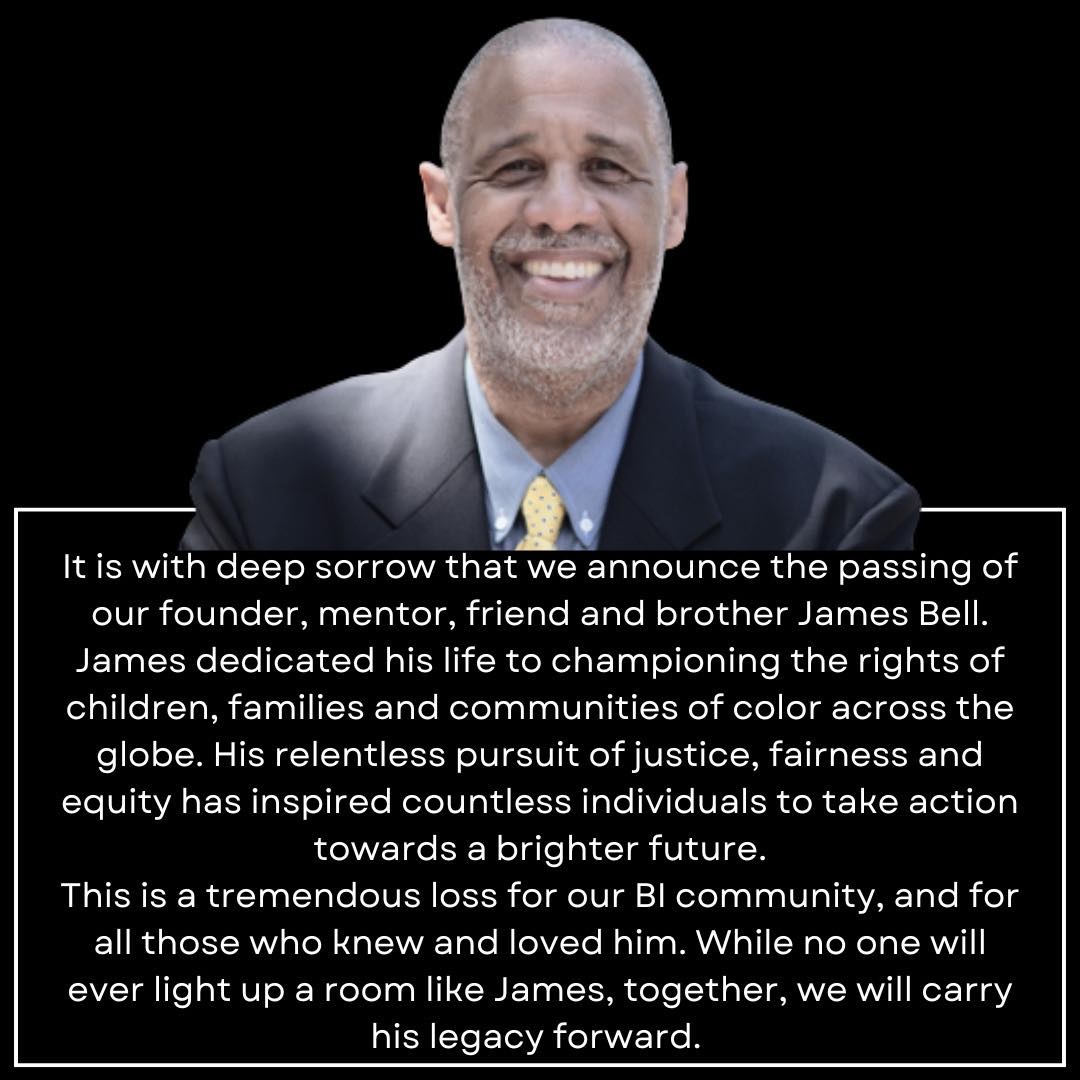
It’s so sad to say goodbye to this giant, James Bell.
He’s gone. And, at the same time, it feels like he is with us still.
Time is a destroyer to be sure, but time is also a witness, and the evidence of James is generous and immense.
He asked me to write a review of his book, and below is what I sent him long ago.

 Bill
Bill
Sorrow’s Kitchen will change the way we think about the criminal legal system and justice, about policing and public safety, and about prisons and prison reform. James Bell offers a unique approach to what are made to seem like intractable problems, and he begins by going to the root and asking us to unleash our most radical imaginations. Why are things the way they are? Where do we come from? What are we, and what can we become? Bell understands and embraces Emily Dickinson’s image of the imagination as a force that can ignite the “slow fuse of possibility,” cracking and sparkling toward what could be or should be, but is not yet.
James Bell’s odyssey through the criminal legal system as a lawyer, an organizer, an activist, and a public intellectual has given him some hard-earned wisdom and the tools to challenge the myths that prop up the whole enterprise. It also makes him a perfect messenger. He argues that, more than a system, what we must confront is an ideology and a dogma, more difficult to identify and harder to unearth. In his effort to challenge the conventional doctrine, Bell foregrounds the arts of liberty—imagination to be sure, but also creativity, initiative, courage, and risk-taking.
James Baldwin once said that the “American Negro has the great advantage of having never believed the collection of myths to which white Americans cling: that their ancestors were all freedom-loving heroes, that they were born in the greatest country the world has ever seen…[Our] tendency has really been…to dismiss white people as the slightly mad victims of their own brainwashing.” James Bell writes in the great tradition of the myth-breakers.
Just as slavery was a defining fact of American life from the Seventeenth to the Nineteenth Centuries, racialized captivity is a central feature in the US today. And just as the abolition of slavery was unimaginable to most Americans then, a society without a bloated prison bureaucracy is difficult for people to wrap their heads around now. But when enough of us become liberated from the dogma of incarceration and the totalizing logic of captivity and control, we might mobilize ourselves to make the radical changes that Bell proposes. We may look back—just as we look back at slavery—with astonishment and anguish as we realize that the prison-industrial complex was a bad choice: it vitalized white supremacy, ruined millions of human lives, devastated social capital, destroyed whole communities, and diminished our society. Slavery made cruelty customary and unkindness conventional, everyone forced to witness and embrace it as such, or to shut their eyes tight as communities were made more hard-hearted and hateful. Just as the abolition of slavery liberated enormous energy toward a more generous and compassionate social order, realizing James Bell’s vision will create the conditions for a more just and decent community for all.
Sorrow’s Kitchen is a generous invitation to join the movement, and it offers a practical on-ramp to get busy in projects of repair. This book is for anyone who is struggling to understand the overlapping crises that characterize our world today, and will, I believe, have an explosive impact.
~~William Ayers


 Posted by billayers
  Bill Ayers