OCTOBER 16, 1965—60 years ago today!

October 16, 2025

On October 16, 1965 I was arrested with 37 other students and two professors from the University of Michigan as we occupied and disrupted the normal operations of the Ann Arbor Selective Service Office (the Draft Board), a part of the massive US machinery of death. I’ve been arrested resisting war and empire, white supremacy and the racial capitalist system countless times since—and there’s no stopping now.
Sixty years! The blink of an eye in the life of the struggle.
KEEP RISING!!!

SEE this FROM MIKE KLONSKY:

Sixty years ago today (10/15/1965) the war makers met their first nationwide wall of resistance. On October 15, 1965, tens of thousands of Americans in over 40 cities took to the streets, campuses, churches, and union halls to protest a war they hadn’t voted for — and no longer believed in. These demonstrations drew over 100,000 participants and included the first public draft card burnings, as well as slogans such as “Hell no, we won’t go!”

This wasn’t a single march. It was a mosaic of resistance. In New York, clergy led vigils. In Berkeley, students staged teach-ins and burned draft cards. Detroit’s protest featured participation from members of the United Auto Workers (UAW), local chapters of the NAACP, and clergy aligned with the Detroit Council of Churches. These groups had already been collaborating on civil rights campaigns — and many viewed the Vietnam War as siphoning resources from the War on Poverty, disproportionately drafting Black and working-class youth, and fueling militarism abroad while neglecting justice at home

The protests were sparked by Students for a Democratic Society (SDS), but they quickly outgrew any one group. SDS was one of the first groups to call for a nationwide day of protest. They helped coordinate actions across dozens of cities, working with local chapters, allied student groups, and sympathetic faculty to organize teach-ins, marches, and civil disobedience.

SDS framed the war not just as a foreign policy blunder, but as a symptom of deeper systemic rot — imperialism, racism, and economic exploitation. Their messaging helped shift the antiwar movement from moral pacifism to radical critique.

.October 15th was a turning point. The war was no longer just a foreign policy debate. It was a moral crisis. A test of conscience. The press downplayed it. The White House dismissed it. But the movement had found its voice. And it would only grow louder, through draft resistance, mass mobilizations, and the radicalization of a generation.

* * *

Phil Ochs’ “I Ain’t Marching Anymore,” released in 1965, was a searing antiwar anthem that became a rallying cry for the burgeoning Vietnam War protest movement. Ochs, a Greenwich Village folk singer and radical journalist, fused biting satire with historical indictment, tracing America’s militarism from the Revolutionary War to Vietnam.

* * *
Today, as we prepare for Saturday’s No Kings protests, the spirit of ‘65 still lives on within many of us.


FREE BUSES!!!

July 19, 2025

It’s the end of the world as we know it,

And I feel fine. ~~R.E.M.

When Zohran Mamdani, the 33-year-old state assemblyman and self-described democratic socialist, decisively won the Democratic primary for mayor of New York City in June 2025, the entire liberal establishment lost its shit. The authorities reached for their fainting hankies, and the tone (if not the exact words) of the rulers and their enablers was unmistakable: “Bolsheviks take over NYC!”

The frenzied commentary ran the gamut: disbelief to delirium, agitation to hysteria, alarm to panic. Now that reality has settled in, the powerful have arrived at what they hope is a broad and reasoned consensus: Mamdani must be stopped at all costs! On the psycho side, the madman-in-chief suggested denaturalizing Mamdani and then deporting him; the realists, after scolding and patronizing the electorate for its misguided idealism leading to the socialist victory, got busy raising millions of dollars to buy the election—for anyone but Zohran. All the talk of the last several months about “saving democracy” and “undermining the will of the people” was shed like a dirty shirt, and the guy Mamdani crushed was dusted off and rehabilitated by the elite. 

It’s as if Mamdani were planning to defund the police, seize the banks, and nationalize the ports as well as the Yankees.

I like those ideas myself, but that’s just me; nothing in Zohran Mamdani’s policy proposals, campaign promises, or past activities suggests that these are anywhere in his sights. In fact,  what’s got the rulers in a tizzy is rather modest: making city buses free, establishing five city-run grocery stores, raising the minimum wage so that working people can afford to live in the city with some dignity, and freezing rents on rent-subsidized apartments. 

But in their minds something devilish is lurking: free buses today, and universal health care looms; rent freezes today, landlords rounded up and sent to re-education camps tomorrow. And before long people will get the idea that housing is a human right, and that everyone has a right to a place to call home. Then what? Food is a human right? Education? There’s no end! 

Plus Mamdani has refused to support Israel’s genocidal assault on Palestinians. He’s an immigrant from Africa, and a Muslim. That’s three strikes right there.

When a leading US Senator was asked by a reporter days after the election if a socialist mayor of the largest American city created problems for the Democratic Party, he responded, “I’m a capitalist.” There were no follow up questions, which was typical, but sad, because I have a few: do you mean that you own the means of production? Or merely that you embrace selfishness, murderous competition, selective humanization that renders large sections of human beings as disposable, and mindless growth—the vilest human qualities and the beating heart of capitalism? But “I’m a capitalist” stands alone—no elaboration, no further explanation needed—because the words “socialism” and “capitalism” function metaphorically in American political discourse: “socialism” is bad, cruel and authoritarian; “capitalism” is good, prosperous and free. 

The 1% promotes the myth that socialists want to make human beings into worker bees or indistinguishable ants in the colony, while capitalists will one day set us all free. Vote for free buses and you’re on a fast-path to the anthill.

In Chicago today we have socialist roads, socialist garbage collection, and a socialist fire department. We’ve agreed as a community over decades of living together that it’s best if everyone’s garbage gets collected by the city, and that the “freedom” to let your trash pile up in your yard or alley is unhealthy and stupid. We also think as a community that it’s a good idea to have a firehouse in every neighborhood rather than wait for a catastrophic fire to erupt, and then take bids from competing private contractors to see who will fight it. After World War II, Chicago took over the privately-owned elevated and subway lines, the street cars and bus companies, and unified and modernized a fragmented transportation system into a public entity. Everyday socialism.

Or as it was called in Milwaukee, “sewer socialism.” Emil Seidel (1910-1912), Daniel Hoan (1916-1940), and Frank Zeidler (1948-1960) were all democratic socialists who ran corruption-free administrations and took a pragmatic approach to governance. They’re remembered for things like building an extensive park system, installing public drinking fountains, and requiring owners to install toilets for workers in their factories.

We have models in the modern world, of course, of socialism without freedom, which is subjugation and control. But if we look honestly at what’s right before our eyes we can see clearly that freedom without socialism is privilege, predation, exploitation, and injustice.

The brutality of capitalism is apparent in every direction: war, invasion and occupation throughout the world exacting tribute in resources and labor from the Global South; militarized police forces at home; white supremacy cemented into law and culture and social structures; super-exploitation of an poorly paid underclass of workers; the looming catastrophic climate collapse; the banality of evil in the increasingly pervasive carceral state. Capitalism willfully and skillfully promotes greed, and turns frenzied accumulation from an obvious vice into an exalted virtue; it deliberately degrades human qualities such as mutual care, kindness, and the sense that we’re all better off when we’re all better off.  

As an 80-year-old person now, I  marvel at the all-conquering nature of capitalism, the ways market competition can be made into a model for every aspect of human life. Take elder-care, the plundering, profit-driven American care system that takes the basic human impulse to care for one another, and transforms it into a market, the Care Industry, with its fangs and talons covered with golden gauze.

If Zohran Mamdani becomes mayor of NY, the capitalists will work overtime to undermine his every initiative, and then proclaim that “once again, socialism failed.”

Let’s fight that—arm-in-arm, shoulder-to-shoulder.

~~Bill Ayers, Chicago 


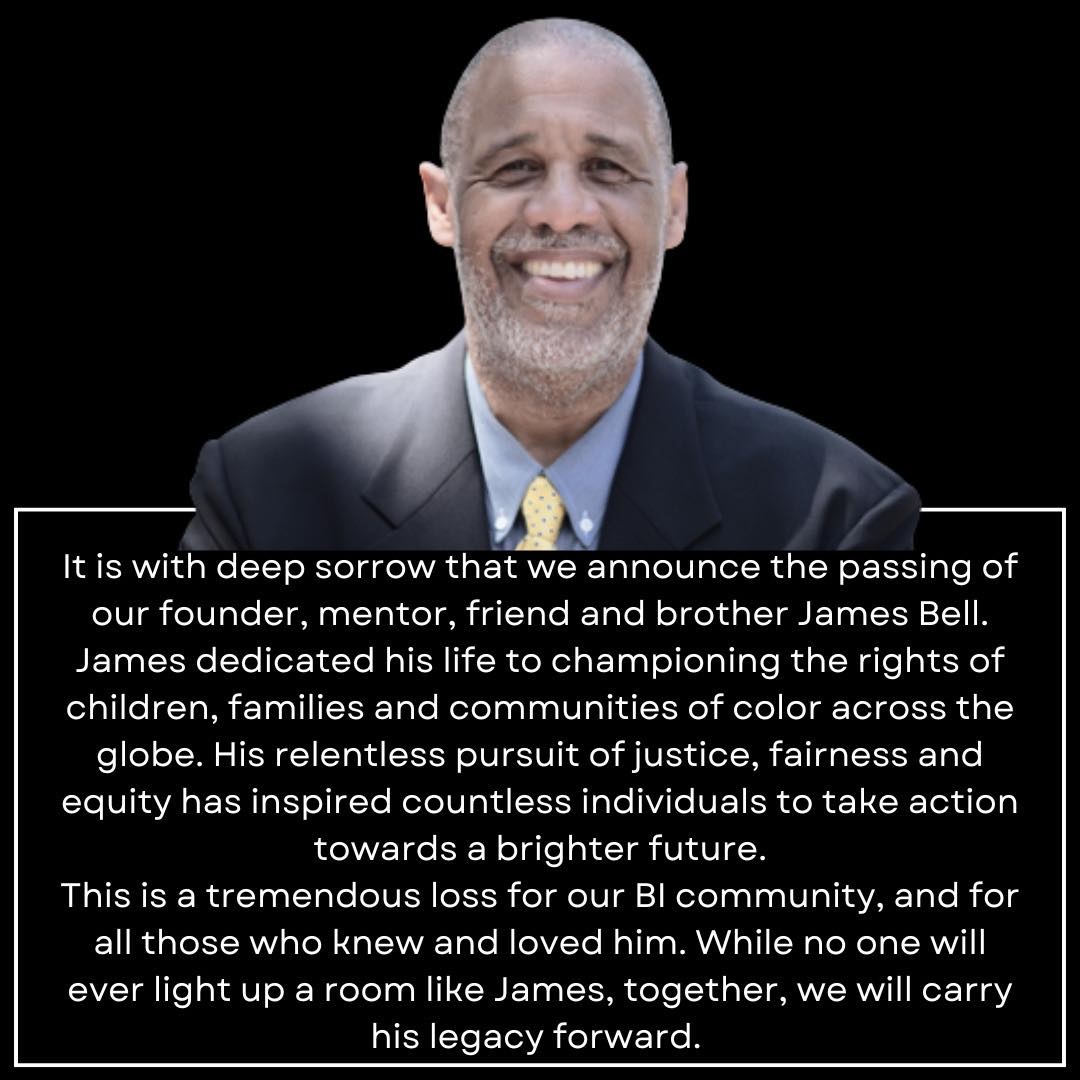
James Bell—Presente!

April 6, 2025

It’s so sad to say goodbye to this giant, James Bell.

He’s gone. And, at the same time, it feels like he is with us still.

Time is a destroyer to be sure, but time is also a witness, and the evidence of James is generous and immense.

He asked me to write a review of his book, and below is what I sent him long ago.

💥🔥💥Bill

Sorrow’s Kitchen will change the way we think about the criminal legal system and justice, about policing and public safety, and about prisons and prison reform. James Bell offers a unique approach to what are made to seem like intractable problems, and he begins by going to the root and asking us to unleash our most radical imaginations. Why are things the way they are? Where do we come from? What are we, and what can we become? Bell understands and embraces Emily Dickinson’s image of the imagination as a force that can ignite the “slow fuse of possibility,” cracking and sparkling toward what could be or should be, but is not yet.

James Bell’s odyssey through the criminal legal system as a lawyer, an organizer, an activist, and a public intellectual has given him some hard-earned wisdom and the tools to challenge the myths that prop up the whole enterprise. It also makes him a perfect messenger. He argues that, more than a system, what we must confront is an ideology and a dogma, more difficult to identify and harder to unearth. In his effort to challenge the conventional doctrine, Bell foregrounds the arts of liberty—imagination to be sure, but also creativity, initiative, courage, and risk-taking.

James Baldwin once said that the “American Negro has the great advantage of having never believed the collection of myths to which white Americans cling: that their ancestors were all freedom-loving heroes, that they were born in the greatest country the world has ever seen…[Our] tendency has really been…to dismiss white people as the slightly mad victims of their own brainwashing.” James Bell writes in the great tradition of the myth-breakers.

Just as slavery was a defining fact of American life from the Seventeenth to the Nineteenth Centuries, racialized captivity is a central feature in the US today. And just as the abolition of slavery was unimaginable to most Americans then, a society without a bloated prison bureaucracy is difficult for people to wrap their heads around now. But when enough of us become liberated from the dogma of incarceration and the totalizing logic of captivity and control, we might mobilize ourselves to make the radical changes that Bell proposes. We may look back—just as we look back at slavery—with astonishment and anguish as we realize that the prison-industrial complex was a bad choice: it vitalized white supremacy, ruined millions of human lives, devastated social capital, destroyed whole communities, and diminished our society. Slavery made cruelty customary and unkindness conventional, everyone forced to witness and embrace it as such, or to shut their eyes tight as communities were made more hard-hearted and hateful. Just as the abolition of slavery liberated enormous energy toward a more generous and compassionate social order, realizing James Bell’s vision will create the conditions for a more just and decent community for all.

Sorrow’s Kitchen is a generous invitation to join the movement, and it offers a practical on-ramp to get busy in projects of repair. This book is for anyone who is struggling to understand the overlapping crises that characterize our world today, and will, I believe, have an explosive impact.

~~William Ayers


CLOSING GITMO IN THE AMERICAN HEART By Robert C. Koehler

February 12, 2025
CLOSING GITMO IN THE AMERICAN HEART By Robert C. Koehler
Gitmo, of course!! It’s the freest place “we” have – by which I mean the American government, a.k.a. Donald Trump. No rules apply there, be they international humanitarian law or the U.S. Constitution. It’s a dumping ground, a black hole.It’s the most secure place for America to hold, as Trump put it a few weeks ago, “the worst criminal illegal aliens threatening the American people. Some of them are so bad we don’t even trust their countries to hold them because we don’t want them coming back.”His plan is to expand the infamous Guantanamo Bay Detention Center, part of the U.S. naval base in Cuba, which George W, Bush began using as he waged his horrific “war on terror” in the Middle East. He began imprisoning alleged terrorists, often arbitrarily arrested, in a hellhole where they had zero rights. Some are still there, several decades later. Trump’s plan is to expand the detention center to hold 30,000 people, which would be, oh, more than double the size of two unforgettable Nazi concentration camps combined: Dachau and Treblinka.And these migrants would be stuck there entirely under the control of an American government that has declared them to be the country’s biggest enemy of the moment: the biggest threat to our national safety. No rights for them!If you want to be a great national leader, this is step one: Create an enemy. Stir fear and hatred, then demonstrate that only you can protect us, by doing what’s necessary: dehumanize, dehumanize, dehumanize. That is to say, keep things simple:  us vs. them. This is what the masses understand, apparently.Oh God, I don’t believe this at all, but the reality of it seems unshakable – with Trump in the White House, more so than ever. There was a time when I believed we were moving beyond the militaristic simplism of Superpower America, with political hope bubbling all the way up to Barack Obama’s election in 2008. Yeah, the Bush era’s dead! But then . . . wars continued, not much changed. Obama had promised to close the Gitmo prison in his first year. That didn’t happen – and that’s when I started to realize that the progressive movement in this country had no real political traction.What we have instead is ongoing outrage, fueled by truth and introspection. Trump wants to “make America great again” and keeps ironically raging about the migrant invasion. The days of American greatness for which he’s reaching go well past the civil rights (the “political correctness”) era, past the women’s rights era, past the Great Depression. America’s greatness began with the European invasion of what came to be called the Americas – several hundred years of obliterating native cultures and dehumanizing them as “savages.” Our “greatness” preceded the American revolution and continued well after it.Trump’s intention to expand the Gitmo prison is symbolic as well as practical: It revitalizes the Bush era war on terror; it brings the war home. Today’s terrorist equivalents are the migrant invaders. If you’re interested in reclaiming the actual history of that period, I recommend the book Witnesses of the Unseen: Seven Years in Guantanamo, written by two Algerian men randomly arrested in Bosnia in 2001: Lakhdar Boumediene and Mustafa Ait Idir. They were falsely accused of being terrorists and spent seven years imprisoned for no reason at Gitmo – pulled away from their wives, their children . . . witnessing, and enduring, horrendous treatment, trapped in the American black hole with zero rights. The book contains fragments of our national history: what we can do in the wake of creating and dehumanizing an enemy.Some years ago, I wrote about the book, about the hell they endured: “stuffed into cages, interrogated endlessly and pointlessly, humiliated, force-fed (in Lakhdar’s case) . . . and finally, finally, ordered by a U.S. judge to be freed, when their case was at long last heard in a real court and the lack of evidence against them became appallingly clear.” This happened thanks to the unending aid they received from a U.S. law firm that spent more than 35,000 pro bono hours litigating the case.“The book is the story of the courage it takes to survive.”As well as alleged terrorists, Gitmo has also long been used to detain immigrants intercepted at sea. At Gitmo, they lacked “access to basic human necessities, appropriate medical care, education, and potable water,” according to the International Refugee Assistance Project. And they had no option to seek asylum in the U.S.What’s different about the Trump plan, according to PolifiFact, quoted at Al Jazeera, is that the U.S. has never sent people who were detained in the United States to Guantanamo. Those arrested here actually had certain rights and protections – which could essentially disappear at Gitmo. Somehow that seems like the point of it all: Americans first. Americans only!Progressive sanity will re-emerge politically, or so I believe, but how this will happen is anything but clear. The Republican right has certain serious political advantages, even if their basic agenda has only minority support. The prime advantage is billionaire dollars backing their cause. And, of course, creating an “us vs. them” governing mentality has a lot more immediate impact than addressing the world – even one’s enemies – with empathy, understanding and a sense of connection.Another difficulty the progressive movement faces is the Democrats, who have drifted ever more centrist-right since the Reagan era, refusing to challenge the Republican agenda head-on and gently cradling the nation’s expanding militarism.It almost seems like we need to start over: Rosa Parks must refuse to give up her seat on the bus again. What might this mean? If nothing else, the truth about American history must continue to flow and efforts to ban it from libraries and classrooms, to burn it in book fires, must be endlessly challenged. And truth still speaks to us from the mountaintop:“So even though we face the difficulties of today and tomorrow, I still have a dream. It is a dream deeply rooted in the American dream. I have a dream that one day this nation will rise up and live out the true meaning of its creed: We hold these truths to be self-evident, that all men are created equal.”Robert Koehler is an award-winning, Chicago-based journalist and nationally syndicated writer. His newly released album of recorded poetry and art work, Soul Fragments, is available here: https://linktr.ee/bobkoehler

My brother Rick Ayers brings the wisdom:

February 2, 2025

January 28, 2024

A friend texted me, “what are we going to do??” OK just a thought here. Disagree if you like. The crisis we are facing is deeper than that Clown DT, and it goes back further. The Republicans and Democrats have been rushing us towards this crisis for decades. Certainly Reagan. But the whole campaign for “globalization” and de-industrialization, for NAFTA, for mass incarceration, for neo-liberal market-based logic to everything, that was all the Democrats. The Dems and Repubs are pretty much on the same team. The bigger movement is the end of the US empire which cannot really be turned around. Both parties are trying to aggressively pick fights with their two adversaries. Is it because they love Ukrainians so much? They love Taiwanese? No, these hot spots far from our shores are hot because the US is desperate to hold on to and extend its imperial grasp. It’s not going to happen. Do I love the Chinese leadership? The Russian leadership? Nope. But I don’t think we should salute our own oligarchs as they push us into these desperate wars. Trump is a clown and a fool but he’s the front man for very determined capitalists who are plotting last-gasp ventures to save the empire. They will fail. We can only fight them so their failure won’t cost too many lives. Yes we must resist DT. But let’s not pretend that this is some unique or worse threat, let’s not feed nostalgia for Biden and his genocidal wars. Everyone seems to be in shock now. Once we get our bearings and the lines are drawn, I trust that people will know what to do.

January 31, 2024

Another random thought: The fight for ethnic studies has been long and hard. It appears that it is now under attack by the “anti-woke” crowd. Let’s remember that the implementation of Black Studies, Chicano Studies, Asian American Studies, really all of ethnic studies was initiated through a long, hard strike at SF State. The establishment has over the years tried to make ethnic studies a non-threatening simple exploration, to domesticate it. But at its core, ethnic studies is a revolutionary rethinking of education and really of what is knowledge, what matters. Now even the mild versions are under attack and it is disgusting. What to do. In the long run, of course, we have to win it back and win it in its true, transformative reality. But for this year and the foreseeable future, I think we need to simply pursue this knowledge outside of the schools. Tucson school district cannot ban a Freedom School which meets a few evenings or on a weekend to delve into Mexican American history and culture. Those who ban books in the schools cannot arrest us for handing out and reading these books outside of school. If the schools won’t educate our kids, we need to do it ourselves. There is a long history of this kind of counter-cultural institutions, like the Freedom Schools in Mississippi in 1964 and after. They were still fighting to change the public schools but they held their own classes too. We can’t just wait around for the idiot politicians to “allow” us to teach and learn. And, think about it, these classes will be allowed to pursue their more radical core ideas once out of the surveillance of the school districts.

February 2, 2025

Reflecting on some parallels between the war in Palestine and our history: remembering the resistance to the American War in Vietnam:

· At first we called for a cease fire, stop the bombing. We were a little naïve perhaps but sincere.

· The US killed Vietnamese in wholesale slaughter, claiming that the evil resistance fighters were using “human shields” and that whole populations were part of a “free fire zone” because they supported the resistance. Three million Vietnamese were killed.

· In time we realized that the Americans were set on a genocidal course.

· Powerful institutions (schools, universities, employers, legislatures) condemned us and enacted draconian measures of repression.

· We conducted research and learned how deeply complicit these institutions were with the genocide.

· Then we worked for the defeat of the American war aims.

· Some asked, “But aren’t you a patriot? Don’t you love America?” We realized that the whole American project was corrupt. No, we were not patriotic.

· Vietnamese General Võ Nguyên Giáp explained openly that war is fought in four ways: violent destruction was one, but the others were moral, psychological, and political. The US was winning on the violence front but steadily losing on the other three. US generals could not understand what he was saying. “The Tet Offensive was a disaster for the Viet Cong, we killed so many!” the generals declared. They couldn’t see what a huge defeat it was, in the US population and in the eyes of the world. Even after the US had to scramble out in defeat, they were shouting, “But we won! The cowardly politicians and radical kids sold us out!”

· The Zionists have exacted devastating terror on the Palestinians, but Israel is forever delegitimized. Eventually, a single secular state with democratic rights (voting) for everyone is the future.


The US Goverment Murdered the Rosenbergs!

January 7, 2025

Mail to: USPardon.Attorney@usdoj.gov

Subject: President Biden, right the historical wrong done to Ethel Rosenberg

To the Office of the Pardon Attorney,

Please urge President Biden to issue a statement before he leaves office declaring Ethel Rosenberg’s conviction and execution wrongful.

Ethel and Julius Rosenberg were executed on June 19, 1953 during the anti-communist hysteria of the Cold War Era. A newly declassified NSA memorandum dated August 22, 1950 – just days after Ethel’s arrest – confirms that the U.S. government knew she was not a spy long before her trial and execution (https://www.rfc.org/why-ethels-execution-was-wrongful).

A formal acknowledgement of the wrong done to Ethel Rosenberg and her family will help prevent similar injustices in the future. Please, urge President Biden to formally exonerate Ethel Rosenberg now. More than 70 years after her unjust conviction and execution, now is the time to right this historic injustice, redress the harm done to the Rosenberg/Meeropol family and finally clear her good name.

Sincerely,

William Ayers


EXCERPT: When Freedom is the Question…

November 21, 2024

When Freedom is the Question…

In Bertolt Brecht’s 1938 play Galileo, the astronomer’s breathtaking discoveries about the movement of the planets and the stars fire a desire to change the world: “The cities are narrow and so are the brains,” he declares boldly. “Superstition and plague. But now the word is: since it is so, it does not remain so. For everything moves, my friend.”1 Galileo wants to free himself and others from the prison of ignorance and delusion that constrains them all, and his truth-telling is revolutionary, challenging the establishment in the realm of its own authority—the church, after all, constructs the human journey as a sanctioned and planned voyage, the steps entirely mapped out in advance with clockwork precision and mathematical certainty. All the support anyone needs abides in the institution of the church itself. Kings are meant to rule, and peasants to obey. Because free inquiry is not authorized, and free thought or free choice are not sanctioned, benighted human beings are imprisoned in foolishness and stupidity.

Galileo resolves to set us free, tilting against the unfreedom of lies and myths and credulousness.

In 1610, the nonfictional, flesh-and-blood Galileo published “Starry Messenger,” describing his observations made with a modern and more powerful telescope, and continued to provide further evidence sup- porting Copernicus’s heliocentric theory. He was asked to stop but he wouldn’t, and when the church had had enough, he was dragged before the Roman Inquisition in 1633, convicted of being “vehemently suspect of heresy,” and sentenced to house arrest until his lonely death in 1642.2

Clearly more than theories of astronomy were at stake. The ideas, surely, but also the joy, the excitement, and the reckless hope all mark Galileo as a free thinker and a freedom fighter—after all, he could have written a book, as Copernicus did, and leave it at that. But he kept pushing, not only for his ideas and his right to interrogate the world but also for everyone to experience the liberation—the freedom—that is impossible without knowledge and awareness. No one can be free with their head buried in the sand.

In Brecht’s play, Galileo’s struggle was punctuated with hope and despair, pain and pressure, and when he finally capitulated to the exquisite torture of the Inquisition, denouncing what he knew to be true, he was received back “into the ranks of the faithful” by the church, even as he was exiled from humanity—by his own words. In the end, he was confronted by a former student, one of his crest-fallen disciples: “Many on all sides followed you with their eyes and ears,” the student said, “believing that you stood, not only for a particular view of the movement of the stars, but even more for the liberty of teaching—in all fields. Not then for any particular thoughts, but for the right to think at all. Which is in dispute.”3 The right to imagine and discuss complex and dynamic truths, the right to think at all, freedom and the liberty of teaching—something that’s in deep dispute in our schools and classrooms now, and in the streets as well.

Like

Comment

Share


On Fascism, from Rick Ayers

November 2, 2024

There’s a lot of talk about fascism now, the fascist core of the far right which is currently led by Trump but which has a long, deep history. We wonder: is fascism here? is it likely to come here? is this like Germany in the 30’s?

I’d like to offer a different thought on it, a different definition of fascism. That is this: fascism is colonial methods brought home to the “mother country.” Italy and Germany had been happily slaughtering colonial peoples in Africa for decades before they began the mass bloodletting inside of Europe.

To worry about fascism, that we “might” be getting fascism, is to ignore the fascist (authoritarian, genocidal) experience of people in the colonies since. . . . since forever. Why not call what Indigenous people have experienced fascism? Why not the enslavement and ongoing murder and oppression of Africans? We worry that there “might be” some fascism in the coming years but what are Black and Brown people experiencing in prison today, in a prison population that has increased ten-fold since the 60’s? Do they join us in wondering, “is fascism coming?” They are living it (and came to it under mass incarceration initiatives by Democrats like President Clinton and Biden during his Senate years, as well as mayors like Eric Adams).

Do the people of Palestine worry about fascism coming? They are living under it, the fire and steel of mass slaughter, today.

If you think of the US not as the immediate borders of the continental US but rather as the extended American empire, then the people of Chile under Pinochet experienced fascism, and that was US-sponsored fascism, even as some trappings of democracy were presented inside the US. Not only Chile, but all over Latin America as well as Africa and Asia, what we call fascism is well practiced.

So will “we” get fascism? I dearly hope not. But let’s not pretend it is some distant thing. And let’s be as determined to end the fascist oppression of colonized peoples as we are for ourselves.